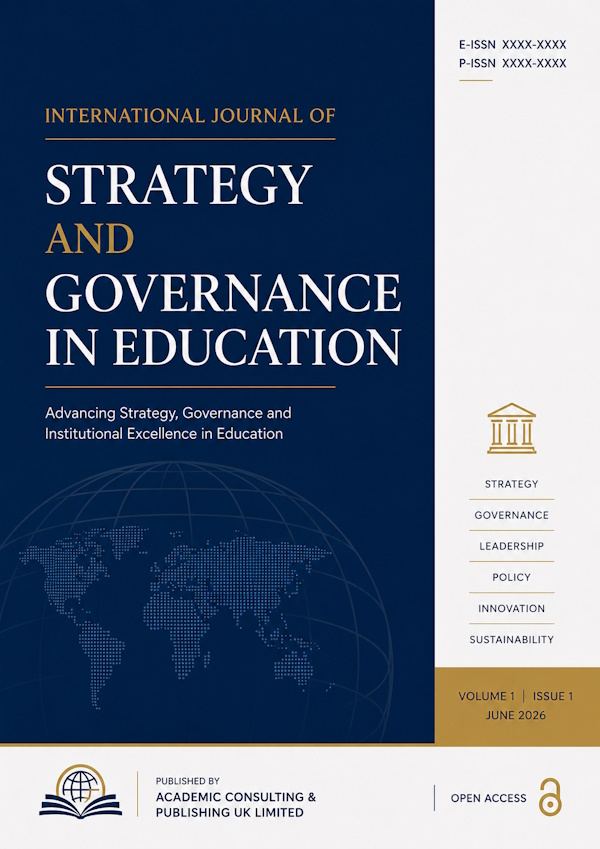
The International Journal of Strategy and Governance in Education (IJSGE) is a peer-reviewed open-access journal dedicated to advancing research on strategy, governance, leadership, and institutional management within education systems and organizations. The journal provides an interdisciplinary platform for scholarly research examining how educational institutions respond to complex societal, political, economic, and technological challenges through strategic decision-making, governance reforms, organizational transformation, and policy development.
CURRENT ISSUE
Volume 1, Issue 1, June 2026
Research Article
International Journal of Strategy and Governance in Education, 1(1), June 2026, 1-16
ABSTRACT:
In emerging research systems, doctoral publication requirements often outpace the support available to early-career researchers. This study examines whether funded project participation is associated with publication productivity among doctoral students and doctoral graduates in Kazakhstan, and whether particular support forms are more closely linked to international and domestic outputs. The analysis uses an anonymous 2025 survey of 808 respondents from six scientific fields and estimates negative binomial models for Scopus/Web of Science and domestic recommended-journal publication counts. Respondents with any project support reported higher raw mean Scopus/WoS output than unsupported respondents (2.05 vs. 1.11 publications). In adjusted models, any project support was associated with 58% higher expected Scopus/WoS publication counts (IRR = 1.58, 95% CI [1.35, 1.86], p < .001), while the association with domestic publications was marginal (IRR = 1.13, p = .057). Salary support and equipment/software support were significant predictors of Scopus/WoS output; field variation was descriptive rather than statistically significant. The findings suggest that project participation matters most when it supplies time, financial stability, and research infrastructure, not merely formal inclusion in funded grants.



Research Article
International Journal of Strategy and Governance in Education, 1(1), June 2026, 17-35
ABSTRACT:
Over the last two decades, education systems have become increasingly digital. This digitalization goes beyond classroom teaching processes; it also raises a governance issue concerning where educational data is collected, who provides the digital infrastructure, and at what level decision-making authority is exercised. Based on the OECD's report comparing 29 education jurisdictions, our study classifies these jurisdictions along four dimensions: the level of centralization of decision-making authority, public control over educational data, whether the digital infrastructure is provided by the public sector or through private platforms, and the binding nature of data protection rules. In our study, we transformed these four dimensions into a digital sovereignty score and evaluated the jurisdictions under four governance typologies. Our findings reveal that digital governance in education is not geographically uniform. In systems with a strong tradition of centralized governance, public control over data and infrastructure is more pronounced, while in systems with high levels of school autonomy, dependence on private providers increases. This study examines this dependence within the framework of data colonialism, arguing that the transfer of educational data to private platforms creates a new problem of digital sovereignty.
Review Article
International Journal of Strategy and Governance in Education, 1(1), June 2026, 36-56
ABSTRACT:
Career self-efficacy has become one of the most influential constructs in career development research; however, existing evidence remains fragmented, with previous studies primarily examining isolated predictors, mediating functions, and contextual influences rather than providing an integrated explanation of how career self-efficacy develops and contributes to students' career development. This study systematically reviews empirical research published between 1996 and 2026 to develop an integrated understanding of how career self-efficacy develops and contributes to students' career development. Following the PRISMA framework, 52 empirical studies were identified and synthesised using a thematic qualitative evidence synthesis approach. The findings reveal that career self-efficacy develops through three interconnected mechanisms: career self-understanding, personal agency, and social learning and support. The review further demonstrates that career self-efficacy functions as the key psychological mechanism linking personal, educational and contextual resources to career exploration, career decision-making, employability and sustained career behaviour. In addition, three categories of boundary conditions - psychological readiness, educational alignment and social and cultural environments - were identified as influencing the strength of these relationships. Based on these findings, the review develops an integrated conceptual framework explaining how developmental mechanisms, mediating functions, and contextual boundary conditions collectively shape students' career development. By integrating fragmented empirical evidence into a coherent process-oriented framework, the review extends the application of Social Cognitive Career Theory by conceptualising career self-efficacy as a dynamic developmental capability rather than a static psychological belief. The findings also provide evidence-informed guidance for educators, career practitioners, institutional leaders, and policymakers seeking to strengthen students' career readiness and successful school-to-work transitions.
Research Article
International Journal of Strategy and Governance in Education, 1(1), June 2026, 57-77
ABSTRACT:
Employability has emerged as a central strategic concern in higher education, requiring institutions to adopt integrated, system-level approaches rather than fragmented skill-based interventions. This study develops a Cognitive Model of Employability that aligns Daubney’s KASE framework (Knowledge, Attributes, Skills, Experience), Kolb’s experiential learning cycle, and Social Cognitive Career Theory (SCCT) to examine how employability is constructed, governed, and operationalised within digital learning environments. Drawing on a systematic theory mapping approach and a thematic analysis of 100 undergraduate student reflections from a virtual internship platform, the study demonstrates how cognitive mediating factors—such as self-regulation, motivation, and metacognition—link experiential learning processes to the development and articulation of employability outcomes. The findings position employability as a cognitively mediated and strategically governed process, shaped by institutional design, pedagogical structure, and individual agency. The study contributes to the field of strategy and governance in education by proposing that employability should be understood as an interaction among designed learning, embedded cognition within curriculum governance, and an integrated system in which employability is strategically scaled, rather than as a fixed list of skills.